.png)
The Untold Truth About Yemeni Coffee Expanding Across America
- Simon & Associates Team

- May 3
- 6 min read

From Ancient Trade Routes to a Modern Cultural Movement
Coffee today is everywhere. It’s fast, branded, optimized, and scaled. But before it became a global commodity, it belonged to one place, one culture, and one system of trade.
Yemen.
While coffee’s earliest origins trace back to East Africa, it was Yemen that transformed coffee into a structured, export-driven global product. By the 15th and 16th centuries, coffee cultivation had spread across the country, especially in mountainous regions like Haraz, where farmers developed terrace systems to grow coffee on steep, unforgiving terrain.
This wasn’t easy land. It required precision, patience, and generational knowledge. Coffee cherries were picked by hand, dried under the sun, and processed using natural methods that are still used today.

From these mountains, coffee made its way to the port city of Mocha, which would go on to define the global coffee trade.
Yemen’s Control of the Global Coffee Market
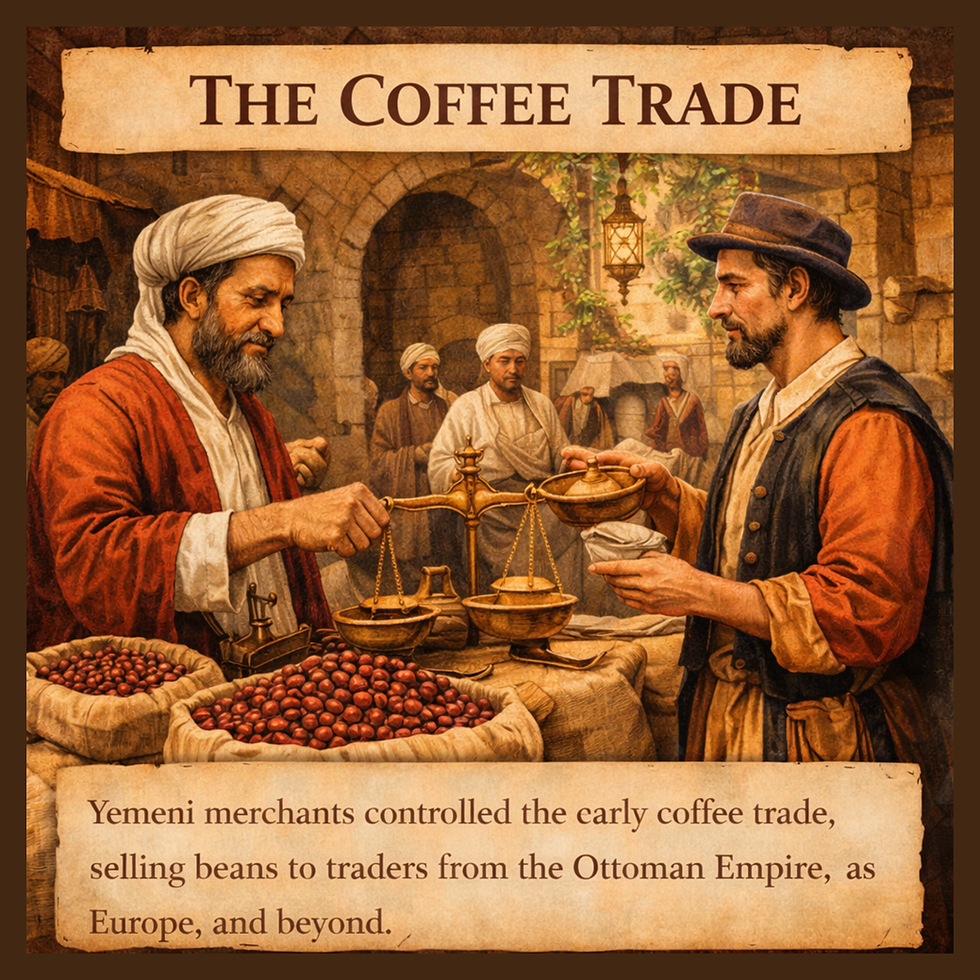
Between the 1600s and early 1700s, Mocha became the most important coffee export hub in the world.
European demand for coffee was growing rapidly, and Yemeni beans were the primary supply.

Ships carried coffee from Mocha to cities like London, Amsterdam, and Marseille, where coffeehouses began to emerge.
These coffeehouses were not just places to drink coffee. They became centers of conversation, business, and intellectual exchange. Some were even referred to as “penny universities” because of the ideas that were discussed inside them.
At this point in history, Yemen wasn’t just part of the coffee trade. It controlled it.
Yemeni exporters even took measures to prevent the spread of coffee cultivation by treating beans before export to make them non-viable for planting. It was an early attempt to protect a monopoly.

The Collapse of Yemen’s Coffee Monopoly
Despite these efforts, the monopoly did not last. European powers eventually succeeded in smuggling fertile coffee plants out of Yemen.

The Dutch began cultivating coffee in Java, while the French and Portuguese expanded production into the Caribbean and South America.
These regions had significant advantages:
Larger, flatter land suitable for large-scale farming
Lower production costs
Access to labor that allowed for rapid expansion
By the late 1700s, global coffee production had shifted away from Yemen.
Yemen went from being the center of the coffee world to a smaller, more specialized producer.
Why Yemeni Coffee Stayed Different
While the rest of the world focused on scaling production, Yemen stayed committed to tradition.
Coffee farming remained:
Small-scale and family-operated
Dependent on rainfall rather than irrigation systems
Focused on quality instead of volume

Regions like Haraz continued producing coffee using traditional methods, resulting in complex and distinctive flavor profiles.
This approach limited Yemen’s ability to compete globally in terms of quantity, but it preserved its reputation for quality and authenticity.
For decades, Yemeni coffee existed in the background of the global market. Known, respected, but not dominant.

A Modern Turning Point: Conflict and Redirection
The Yemeni Civil War created a major shift.
Economic instability, damaged infrastructure, and limited export capabilities made it increasingly difficult for Yemeni entrepreneurs to build and scale businesses within the country.
Rather than waiting for conditions to improve, many made a strategic decision to invest abroad.
The United States became a key destination.
This was not just migration. It was a calculated shift toward stability, opportunity, and long-term growth.
Yemeni Communities in America
Yemeni communities had already been established in parts of the United States, particularly in cities like Dearborn, Brooklyn, and Houston.
Historically, many Yemenis worked in small businesses such as grocery stores, gas stations, and retail operations.
Over time, a new generation emerged.
This generation grew up in the U.S., understood the market, and had the ability to combine cultural identity with modern business practices.
And they chose coffee.
The Rise of Yemeni Coffee Shops in America

Over the past decade, Yemeni coffee shops have expanded rapidly across the United States.
These cafés offer something different from traditional coffee chains.
They emphasize:
Authentic flavors, including coffee infused with cardamom and spices
Traditional Yemeni pastries
A welcoming, community-focused environment
Extended hours that cater to late-night customers
Rather than competing on speed or price, they compete on experience.
Customers are not just buying coffee. They are engaging with a culture.
The Five Real Reasons Behind the Growth
The growth of Yemeni coffee in America is not accidental. It is driven by a combination of factors working together.
1. Adversity Forced a Smarter Strategy
Challenges in Yemen pushed entrepreneurs to invest in stable markets like the United States. What started as necessity became a long-term business strategy.
2. A Generation That Is Fully Invested
Younger Yemeni-Americans are building businesses as permanent investments, not temporary opportunities. They understand both cultures and know how to position their brands effectively.
3. Selling an Experience, Not Just a Product
Yemeni coffee shops offer something different. From flavor profiles to atmosphere, they provide a cultural experience that stands out in a crowded market.
4. Growth Fueled by Shared Knowledge
Within the community, information spreads quickly. Entrepreneurs learn from each other, allowing new businesses to start stronger and grow faster.
5. Independent Brands, Connected System
While many shops operate under different names, they are often connected through relationships and shared experience, creating a strong support system behind the scenes.
A Full-Circle Moment in Coffee History
Centuries ago, Yemen introduced coffee to the world through Mocha.
Today, Yemeni entrepreneurs are reintroducing it in a different way.
Not by controlling global supply, but by controlling the experience, the branding, and the story.
Cities like Sana'a, Taiz, and Shibam continue to influence this movement through culture and identity.
What appears to be a modern trend is actually the continuation of a centuries-old legacy.
Why Are So Many Yemeni Coffee Shops Suddenly Opening Everywhere?
The Real Shift: A New Generation
This new generation is different.
They grew up in America. They went to school here. They understand how business works in this market. Many have already worked in different industries, built experience, and earned capital.
Now they’re making a different move.
Instead of just working, they’re investing.
And they’re choosing to invest in something that connects back to their roots.
Yemeni coffee.
From Making a Living to Building Identity
For this generation, opening a coffee shop is not just about income.
It’s about identity.
After years of building themselves professionally, many Yemeni-Americans are now putting their own money into businesses that reflect who they are. Instead of separating culture from business, they’re combining the two.
That’s why these cafés feel different.
They’re not just businesses.
They’re statements.
Why Coffee Became the Focus
Out of all industries, coffee became the natural choice.
It connects directly to Yemeni history. It’s something deeply understood within the culture, but still new to many American consumers.
It offers both familiarity and uniqueness.
That combination creates opportunity.
How Growth Actually Happens
From the outside, it looks like Yemeni coffee shops are suddenly everywhere.
But the growth isn’t random.
It follows a pattern.
One entrepreneur opens a café. It succeeds. Others watch, learn, and improve on the model. They apply what works, avoid what doesn’t, and move faster.
At the same time, there is constant communication behind the scenes.
Advice is shared. Suppliers are recommended. Mistakes are avoided collectively.
It may look like competition.
But in reality, it’s coordinated growth.
The Yemen War Accelerated Everything
The Yemeni Civil War didn’t just create challenges.
It changed priorities.
Parents who once imagined their children returning home began encouraging them to build their future here instead.
Not just to work.
But to invest.
This shift pushed a generation to think long-term in the U.S., leading to more businesses, more ownership, and more expansion.
Yemeni Coffee in America Today
Across cities like Dearborn, New York City, and Houston, Yemeni coffee shops are becoming part of the landscape.
These cafés offer something different:
Authentic flavors like cardamom-infused coffee
Traditional pastries
Late-night environments focused on community
Spaces designed for connection, not just transactions
They are not trying to copy existing coffee chains.
They are building something of their own.
A Full-Circle Moment
Centuries ago, Yemen introduced coffee to the world through Mocha.
Today, Yemeni entrepreneurs are bringing it back in a new way.
Not by controlling supply.
But by controlling the experience, the culture, and the story.
Cities like Sana'a, Taiz, and Shibam continue to influence this movement through people and identity.
What looks like a sudden trend is not new.
It’s a legacy.
Rebuilt by a generation that chose not just to work, but to invest, grow, and represent where they come from.
About the Author
Simon Saleh is the Managing Director of Caffeena Coffee House, a Michigan-based coffee brand focused on bringing authentic Yemeni coffee culture to modern communities across the United States. Through multiple upcoming locations and partnerships, Caffeena aims to redefine the coffee experience by combining tradition, quality, and community-driven spaces.
Website: https://caffeena.com
Real Estate: https://simonsaleh.com
Sources & References
This article draws on historical research and industry insights from the following publications and organizations:
Smithsonian Magazine – The Origins of Mocha and Yemen’s Role in Coffee Trade
https://www.smithsonianmag.com/smart-news/your-mocha-named-after-birthplace-coffee-trade-180965016/
Encyclopaedia Britannica – Mocha: Historic Coffee Port of Yemen
National Coffee Association (USA) – History of Coffee
Perfect Daily Grind – Tracing Coffee’s Roots Back to Al Mokha, Yemen
https://perfectdailygrind.com/2019/06/tracing-coffees-roots-back-to-al-mokha-yemen/
Perfect Daily Grind – The History of Mocha & Yemeni Coffee Culture
https://perfectdailygrind.com/2017/09/the-history-of-mocha-coffee-yemeni-coffee-culture/
World Coffee Research – Coffee Origins & Cultivation
International Coffee Organization – Global Coffee Production & Trade Data
Reuters – Economic Impact of Conflict in Yemen
Al Jazeera – Yemeni Diaspora and Business Expansion


Comments